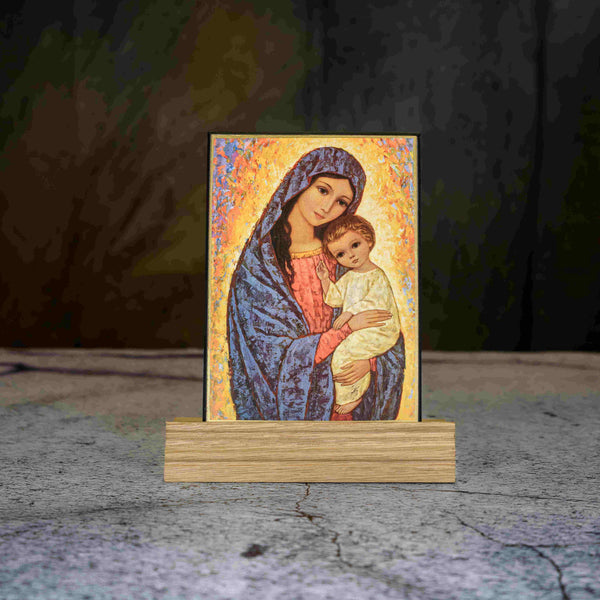
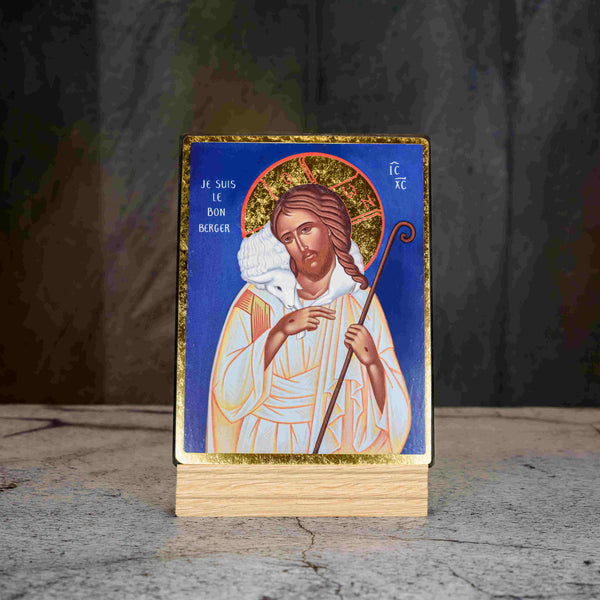
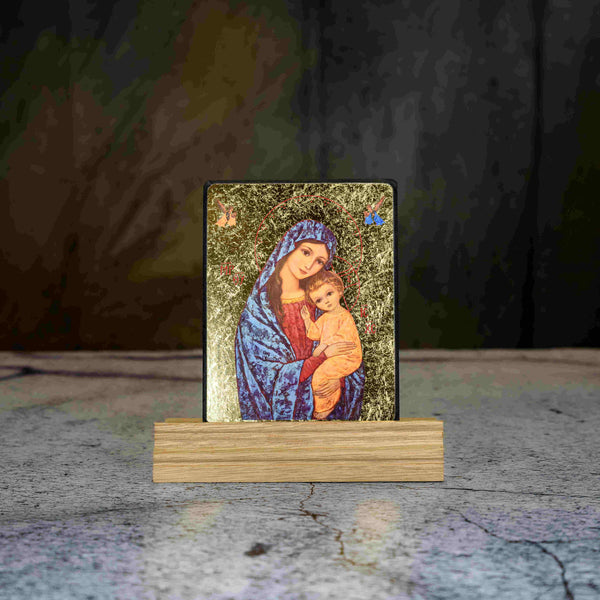
A short answer to the question we get most often, what gilding actually is, what hand-gilding does to a wood panel, and why the finish matters more than the photo on a screen.
The word "gilded" gets thrown around quite freely on the internet. It is on candles, on photo frames, on tote bags. It can mean almost anything, from a screen-printed yellow to a thin metallic plastic film glued to a surface. So when a workshop says hand-gilded, it is fair to want to know what they actually mean.
For us, hand-gilded means one thing. Leaf applied by hand, sheet by sheet, onto a prepared wood panel. No paint, no print, no metallic foil. The metallic shimmer you see on the icon is the material itself, not a pigment.
The four steps of the process
From the moment a panel of wood arrives at the workshop, four things happen, in this order.
- Preparation. The panel is sanded, sealed, and primed with several coats of gesso, so the surface is smooth and absorbent enough to hold the leaf.
- Bole. A thin coat of red clay is laid down in the areas that will be gilded. The bole acts as a soft cushion for the leaf and gives it its warm tone underneath.
- Gilding. Sheets of leaf are picked up one by one with a fine brush and pressed onto the bole. The leaf is then burnished, gently rubbed with an agate stone, until it takes on its mirror-like shine.
- Varnish. Once the painting and the gilding are done, the whole panel is finished with a coat of enamelled varnish, painted by brush. Icon by icon.
Why this matters in your living room
Hand-gilded leaf behaves in a way that no print or metallic ink can imitate. It catches the slightest change of light, the morning sun, a candle in the evening, an overhead lamp. The icon changes through the day. It is not always loud about it, but it is always doing it.
Photographs on a screen cannot show this. The shine you see in our product photos is closer to a flash of glare than to what the piece actually does at home. This is, by the way, why we ask for a little patience when an icon arrives. Take it out of its packaging, set it on a table near a window, and watch it for a few minutes. It does the work itself.
"Hand-gilded leaf catches the slightest change of light. The icon is never quite the same twice in the same day."From the workshop
What we do not do
For the sake of being clear, here are the shortcuts we have decided against, even when they would save us time and money.
- We do not use metallic foil. It looks fine for the first year, then it dulls and flakes.
- We do not use metallic-toned paint or print. It looks flat under any light.
- We do not skip the bole. Without it, the leaf sits on a cold surface and never warms up.
- We do not subcontract the gilding. Every sheet is laid by one of our two iconographers, in our workshop.
If a piece is described as a "gilded finish" anywhere on the internet for under twenty euros, it is almost certainly one of the four shortcuts above. There is no shame in that, it is a different product. But it is not what we do, and not what we are selling.
A last note on small variations
Because every step is done by hand, two icons of the same reference will never be perfectly identical. The bole will catch the light at a slightly different angle, the brush will leave a slightly different rhythm in the varnish. We see these as features, not as defects. If a piece feels off to you when it arrives, write to us, we read every email.